
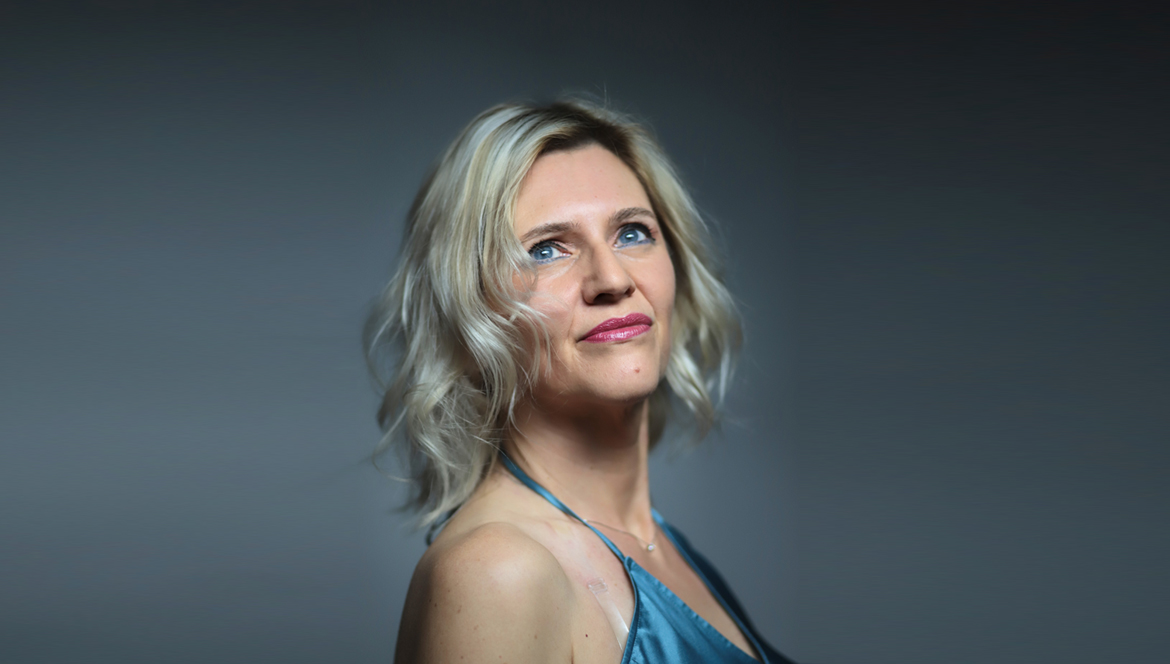
Marlena Maciejkowicz’s lyricism and technique bring a flourish to the GOG’s open-air Nocturnes at the Doge’s Palace
Post Author: Giulia Cassini
Article Published: August 9, 2024
Post Category: Concerts
Excellent lyricism and technique for the final GOG event at the Doge’s Palace with I Notturni en plein air, which celebrated its tenth anniversary with a truly exceptional program, which covered all, and I mean all, of Chopin’s Nocturnes.
Marlena Maciejkowicz’s piano recital, expertly introduced by GOG director Maestro Pietro Borgonovo, was essentially divided into two parts: Frédéric Chopin, with six of the most famous Nocturnes, and Sergei Rachmaninoff, with six pieces from Etudes-Tableaux.
Her interpretation of the Nocturne in F-sharp major, Op. 15 No. 2, and that in G minor, Op. 37 No. 1, were particularly interesting. In the former, she rendered the embellishments impeccably and without affectation, contrasting them with the poignancy and persistence of the themes, enriched and never diminished by arpeggiated chords, or by appoggiaturas. The large audience also enjoyed the rush of movement in some passages, more than a simple rubato, conveying all the turmoil and denser harmonies contrasting with the atmospheric closure of the first part of the piece, with evident softening. In the Nocturne, Op. 37, No. 1, the chorale in the central section is striking for its unity and compactness, with a very marked roundness of sound, in addition to the tenderness of the second section and the extremity of the sonorities with a repose in the final chord.
Sergei Rachmaninoff exudes great emotion thanks to his dynamic, captivating pianism, capable of seamlessly shifting between virtuosity and introspection, back and forth, even with evident and deliberate “fractures.” Some studies would perhaps have expressed an even clearer connection to Chopin, from the study Op. 25 no. 4 to the most famous Ballade no. 1, but even those chosen have obvious references and a writing evidently influenced by the composer himself. A parallel perhaps more felt than others with the interpretation of the study in D minor Op. 33 no. 5, which gives a nod to Chopin and in which the right hand gives great proof of acrobatics. The audience was extremely warm with long and deserved applause under the stars, thanks to a substantial maintenance of the same level throughout the concert and an elegant stage presence that underlined sobriety and style.
S. Rachmaninov: Etudes-tableaux op.33, op.39, Ars Musici
(…)Given the enormous demands on physicality, technique, and creative power, it seems hard to imagine that a 26-year-old newcomer is up to the task. But Polish pianist Marlena Maciejkowicz is, and she offers a perspective that certainly holds its own alongside the classical recordings of prominent performers. The pianist, trained by Michel Béroff and Hans Leygraf, not only possesses astonishing manual skills, allowing her to tackle even the most hair-raising passages with almost effortless ease, but also a rich and powerful Rachmaninoff tone; and her performance is so vivid that the pictorial character of these etudes is almost unmistakable. The zither figures in the A minor Etude, Op. 33, 6, come across as polished, and the Etude, Op. 33, 7, seems like an opulent soundscape with ringing bells. Incidentally, Marlena Maciejkowicz provides counter-evidence to the widely held view that women should steer clear of Rachmaninoff’s great pieces. Absolutely not!
PIANO NEWS, 2/04
(…)Marlena Maciejkowicz really has something to say about the Etudes-tableaux. First of all, she does not approach them “with fingers of steel.” One only has to listen to the beginning of Op. 39 No. 1 to be convinced of this: she enters the whirlwind of sound gently (admirable Op. 33 No. 2, with its pretty arpeggiated waves). Throughout both opuses, it is this gentleness, or rather this tact, which will prevail… She also knows how to seek out mysterious climates (Op. 33 No. 5), where some highlight the pianistic splendor. Unlike many ‘esprits frappeurs’, Maciejkowicz does not unleash her wrath and perfectly masters the rises of power, preserving, in addition to the quality of the sound, a great clarity of the sound planes (Op. 39 No. 9). Even when Rachmaninoff’s writing could slip into a certain convention (the beaten chords of Op. 39 No. 5), it creates a real dramatic tension, or rather, it brings the convention to life.
A grand and beautiful recital dedicated to a composer still largely unknown to the French public.
WWW.CLASSICSTODAYFRANCE.COM
Characteristic Jewels of Piano Music
A piano recital of exceptional quality and intensity… In Kirchhatten, the Italian-based artist presented herself with absolute bravura, performing characteristic jewels of piano music by Brahms, Schubert, Chopin, and Rachmaninoff… This unique interpretation opened up a very special musical world to the impressed audience, which was honored with sustained applause.
NORDWEST ZEITUNG
Marlena Maciejkowicz: Sculpted Piano Sound
(…) The first movement of the “Moonlight Sonata” is rarely heard so unearthly, but so hesitant, tentative, and colorful in its half-sounds; she expands Brahms’s Opus 9 in meditative breadth; Handel’s Chaconne takes on romantic pathos. Maciejkowicz reaches his goal with Liszt: her firm hand and rock-solid technique prove themselves, as does her ability to force expressionistic gestures and contrasts into a magnificent arc. Great cheers, Chopin’s D-flat major Nocturne
as a dark, subdued encore.
BADISCHE ZEITUNG
Enchantment at the piano with Marlena’s music
Marlena Maciejkowicz plays the piano with truly astonishing ease. There’s no apparent effort, even in the most technically challenging and virtuosic passages… Maciejkowicz approached Debussy’s six sound images (Images) with rich detail… Well, we believe that Maciejkowicz’s interpretation, thanks precisely to her natural relationship with the keyboard, was able to highlight the myriad nuances of timbre and dynamics… With Scriabin’s Sonata, Marlena Maciejkowicz revealed virtuosic gifts and the ability to skillfully transition from moments of great strength and tension to moments of extreme delicacy…
LA PROVINCIA
Enormous dynamics
It’s not every day you hear a pianist who understands how to realize such powerful concentrations of sound on her instrument as Marlena Maciejkowicz did in her impressive recital on Sunday evening in the Historischer Kaufhaussaal. In Schumann’s Fantasiestücke Op. 12, Maciejkowicz’s technical brilliance and a broad range of piano sound combine to develop the diverse characters of the eight highly virtuosic pieces with great plasticity.
The way the Polish pianist captures the tremendous tempo of the movement in “Traumes Wirren” in a single measure and then storms onward, the way she musically portrays this shift in mood, is simply astonishing…
BADISCHE ZEITUNG
The grand gesture dominated
(…) As succinctly as Beethoven presented his theme (WoO 80), as directly Marlena Maciejkowicz drew the listeners into the action. She utilized a wide dynamic range to keep the austere, robust movement moving. Even in outbursts of extreme power, however, she maintained her noble, grand piano tone….Marlena Maciejkowicz demonstrated her perfect command of the grand
performance, across the orchestra pit, so to speak.
BADISCHE ZEITUNG
Marlena Maciejkowicz: So precise, so clear
The “Aria with various variations for the clavichord,” which Bach wrote for his student Johann Gottlieb Goldberg, is unlikely to have helped with Baron von Kaiserling’s insomnia. At least not if Goldberg had played the way Marlena Maciejkowicz, polish pianist living in Germany, did in the Kaufhaussaal: so precise, so transparent, so clear, and so exciting, right down to the repeat of the aria at the end, which now seems so much more essential than at the beginning.
The Goldberg Variations, played here on the piano, were incredibly exciting in their dynamic development of the linear texture. Marlena Maciejkowicz’s technical brilliance was also evident in Chopin’s Préludes. The way the pianist illuminated the molto agitato of the dense figuration surrounding the chiseled middle voice melody in the 8th Prélude, for example, how she guided her left hand completely freely in the 3rd, and how she laid the rhythmic foundation for the Presto con fuoco in the 16th with an eminently striking evocation: captivating, thrilling, first-class.
BADISCHE ZEITUNG
Young pianist transports listeners to a dream…Emotional and sensitive…a name to remember…
NORDWEST ZEITUNG
(…) a true virtuoso…pianistic bravura, boundless verve and captivating vitality…
The audience’s enthusiasm knew no bounds. GOSLARSCHE ZEITUNG
(…) an already mature artist…powerful, confident, energetic…astonishing mastery…sweeping the orchestra with her temperament.
HILDESHEIMER ALLGEMEINE ZEITUNG
(…) expectations even exceeded… Marlena Maciejkowicz captivated the audience…stylistic confidence, technical perfection, and profound expressiveness…a confident designer of musical contrasts and
developments…brilliantly virtuosic…energetic, confident, with an almost volcanic temperament.
BERSENBRUECKER KREISBLATT
Elzbieta Penderecka, general director of the Ludwig van Beethoven’s Eastern Festival and the Piano Festival in Warsaw: I’m glad that Marlena Maciejkowicz accepted my invitation for the Piano Festival. She is a multifaceted, highly developed and outstandingly prepared pianist.
TWÓJ STYL, 1/05
(…) a perfect virtuoso and a captivating musician, captivating with her magnificent technique and outstanding musical intelligence. She combines temperament, instinct, and taste… a great artistic personality.
Vitaly Margulis
Marlena Maciejkowicz was one of my most talented pupils. In her piano playing she combines a remarkable technique together with a sensitive musical spirit and an artistic personality of great interest. Her interpretations are conscious and intelligent, but also very expressive and emotional.
Hans Leygraf (University Mozarteum Salzburg)